Perceived Control vs. Real Performance: How Your Advertising Account at ADDITIVE Delivers Maximum Clarity

Who should own the ad accounts on Google, Meta, and other platforms – the hotel itself or the agency? What is often framed as a question of “independence” is, in reality, a decision between technical isolation and maximum performance. In this article, you will learn why the agency model with ADDITIVE is the decisive lever for successful hotel marketing.
Hotel-Owned vs. Agency-Managed Accounts:
Comparing the Two Advertising Account Models
- With the client-owned ad account, the hotel is the direct owner of the ad account. The contract and billing of the advertising budget take place directly between the hotel and the platform (e.g., Google). The agency receives a guest access login to operationally manage campaigns.
- With the agency-owned ad account, the respective partner instead sets up a separate ad account for the hotel and takes over the full technical management. Billing of the advertising budget is done directly between the agency and the platform and is issued to the hotel as a consolidated invoice.
Why Owning the Advertising Account Does Not Automatically Mean You Have Control
In the hotel industry, the recommendation persists that ad accounts should generally remain in the hotel’s own possession and that external partners should be granted access rights only. This concern is understandable: the desire for independence, transparency and control is essential for hoteliers as entrepreneurs.
In addition, this need has often grown historically, as many hotels have experienced budgets being spent without the economic impact being transparently proven. The logical consequence is demanding access to the ad account. However, this access does not solve the structural challenges of modern advertising platforms – and creates additional risks.
The Risk of Hotel-Owned Accounts: When Campaigns Suddenly Stop Running
How quickly an in-house account can become an economic risk is illustrated by a scenario that occurs in reality more often than expected: it is peak season and demand is booming - yet suddenly the hotel’s online visibility disappears. Ads are paused even though they generated bookings yesterday: an expired credit card, a new policy notice overlooked in day-to-day operations, or technical issues are the most common reasons for this.
The economic consequences are immediate: while your own presence disappears, online booking platforms (OTAs) like Booking.com or competitors absorb the demand. Direct bookings are lost - not due to lack of demand, but due to missing technical continuity.
Help with troubleshooting and an individual solution so the ads are running again quickly? Not available.
The biggest disadvantage of an in-house account is not the technology, but the lack of market power when it matters. We will look at what this means next.

Why Individual Hotel Advertising Accounts Face Disadvantages on Google and Meta
As an individual hotel, advertising platforms like Google or Meta consider you a "micro-advertiser" - making you essentially invisible to these global tech giants. This is particularly evident in the following areas:
1. Premium Support Through Market Power:
While “micro-advertisers” with standalone accounts often end up in automated standard support loops when issues arise, agency structures secure access to dedicated contacts. Access to individual support or a fast solution is therefore limited for individual hoteliers. Delays or unresolved ad disapprovals - or even account suspensions - directly affect visibility and thus the hotel’s direct distribution.
2. Stability & Continuity Through an “Agency Safety Net”:
In centrally managed systems, a safety net ensures continuity of campaigns. Partner agencies maintain direct exchange with platform account managers and also bill advertising budgets directly with the respective platform. For hotels, this not only means more operational security in marketing but also considerable relief for accounting: instead of numerous individual debits, a monthly aggregated invoice is provided clearly and cleanly prepared for tax purposes.
3. Official Partnerships Provide Access Advantages That Standalone Accounts Cannot Achieve:
Here, the circle closes on the topic of market power. What a single hotel account cannot technically achieve becomes possible through an agency network: in professional digital marketing, official partnerships with platforms such as Google, Meta, or TikTok play a substantial role.
Official partnerships with international advertising platforms are based on enormous advertising volumes that normally only corporations such as Booking.com, Expedia, Airbnb, or large hotel chains can achieve. For individual hotels, these accesses are generally out of reach. By bundling many hotel campaigns, ADDITIVE attains exactly this status. This creates leverage from which individual hotels benefit - despite limited individual budgets - by gaining access to the added value that results:
- Ongoing certified quality checks by the advertising platforms themselves
- Early access to new features and campaign formats
- Participation in innovation and “first-mover” projects
- Promotions and advertising credits for new customers as part of special offers
- Dedicated premium contacts for fast, high-quality support and individual problem-solving
<div class="article_quote"><div class="article_quote_contain"><div class="article_quote_quote">"ADDITIVE is among the top 3% of Google Premium Partner agencies - a clear proof that processes, campaign standards and ongoing optimization are consistently reviewed and always aligned with the highest quality and performance standards.”</div><div class="article_quote_name u-text-style-main">– Joachim Leiter, Executive & Head of Marketing and Sales</div></div></div>
What Does This Mean Specifically for ADDITIVE Customers?
For ADDITIVE customers, this means that there are not only formal certifications with the individual platforms, but that real, operationally usable synergies are created for hotels.
The close cooperation with the world's leading advertising platforms is also reflected in concrete projects and exclusive access that ADDITIVE has been able to secure for its customers thanks to premium partnerships:
- Official pilot test of the new AI campaign format on TikTok in the hotel industry
- Exclusive use of Google travel data in ADDITIVE campaigns through access to the "Google Travel Analytics Center"
- “AI Max” beta test with Google on AI-based campaign strategies before the official launch
- Successful test projects with Meta in lead generation, with results presented in the official “Meta Earnings Call”
In addition, ADDITIVE is among the top 3% of Google Premium Partner agencies in Italy - an indicator of trust that goes beyond Google itself and is also reflected in campaign quality, preferred account support, and faster problem resolution.
4. Enhanced Security and Liability Protection Through Centralized Account Management
Advertising accounts are becoming increasingly attractive targets for cyberattacks, especially because they often contain stored payment information. If cybercriminals gain access to a hotel-owned account, they can quickly spend substantial amounts on unauthorized campaigns using the hotel’s stored credit card. The financial damage often occurs before the hotel even notices the breach.
With an agency-managed account, however, the agency handles all payment processing centrally. The hotel does not store its own credit card in the advertising account and therefore does not face immediate financial exposure in the event of an attack.
Agency-managed accounts also benefit from centralized security monitoring and faster response times when suspicious activity occurs. Irregularities are easier to identify across a large portfolio of managed accounts than within an isolated individual account.
Why an Ad Account Alone Still Does Not Create Transparency
However, the structural disadvantages of standalone accounts are only one side of the coin. Even if you disregard these limitations, there are additional points that matter. Above all, there is the assumption that owning an account - and the ability to “look into the account at any time” - automatically creates full transparency for hotel businesses.
Often, the exact opposite is the case: While the isolated dashboards of Google or Meta show marketing data, they do not reflect entrepreneurial truth. We highlight two of the biggest challenges below:

Pitfall 1: The Limits of Isolated Channel Evaluation
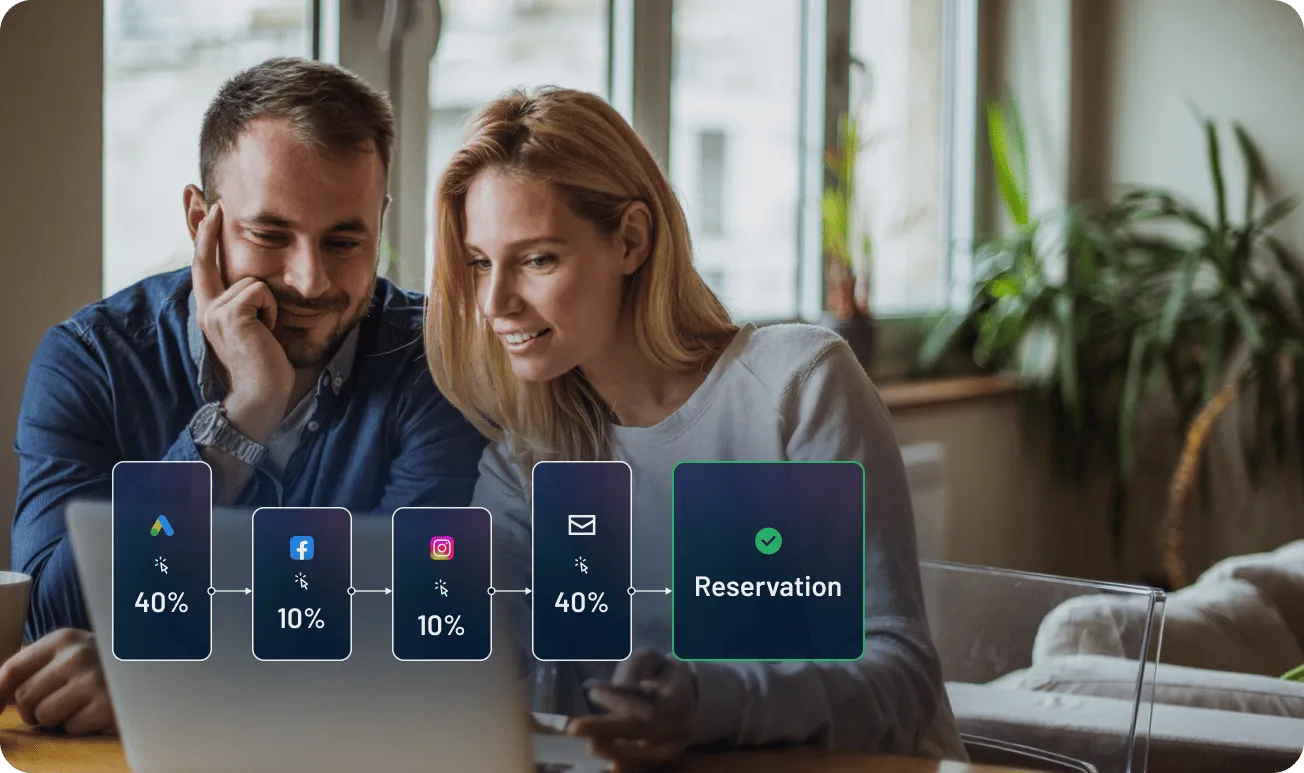
Whoever evaluates marketing channels separately overlooks central connections. Measures that do not deliver the decisive "last click" before an inquiry or booking appear inefficient in isolated reports - even though they contribute crucially to the final booking decision.
A practical example: A potential guest sees an emotional hotel video on Instagram but does not book yet. A few days later, he actively searches for the hotel on Google and finally books. In an isolated view, no booking is attributed to Instagram, even though the impulse was set there.
<div class="article_quote"><div class="article_quote_contain"><div class="article_quote_quote">"Guests do not book via a single platform. They see social media ads, compare on Google, and read reviews before booking. Those who only evaluate the last click often reduce exactly those measures that generated the demand in the first place."</div><div class="article_quote_name u-text-style-main">– David Weitlaner, Head of Digital Marketing</div></div></div>
Pitfall 2: The Trap of “Cheap Clicks”
In practice, campaign success is often evaluated using generic metrics from the ad platforms, such as cost per click (CPC). This is exactly why looking into the Google Ads account or Meta Business Manager can be misleading.
A practical example: A hotelier logs into their Google Ads account and sees very good numbers: thousands of impressions, many clicks, and an extremely low cost per click. This creates a good feeling because low click costs and high click-through rates seem successful at first glance - the budget appears to be used efficiently to generate maximum reach.
But it is precisely these traditional platform metrics that often contradict the economic outcome. Campaigns that are strictly optimized for revenue and reservations - instead of just impressions and clicks - very often show "worse" classic metrics at first glance.
The reason is user intent: a user who is only looking for inspiration (e.g., searching for “beautiful hotels in the Alps”) clicks quickly and incurs low costs - but the likelihood of an immediate booking is very low.
Conversely, a user who is already searching with clear purchase intent (e.g., “book a wellness hotel in South Tyrol”) is “hot” to book. These purchase-ready users are fiercely contested in the market, and the click is therefore significantly more expensive.
<div class="article_quote"><div class="article_quote_contain"><div class="article_quote_quote">“Low-cost clicks are often just ‘cheap’ attention. What matters is whether clicks turn into real direct bookings. And you don’t see that in the ad account - you only see it where reservations are actually recorded: in your Property Management System (PMS)."</div><div class="article_quote_name u-text-style-main">- Joachim Leiter, Executive & Head of Marketing and Sales</div></div></div>
The Solution:
From an Isolated Ad Account to a Holistic Approach with ADDITIVE
Connectivity Instead of Isolation Thanks to a Holistic Online Marketing System for Hotels
To reliably evaluate such correlations in everyday marketing, an isolated view of individual platforms is not enough. This requires a networked platform that:
- Connects all advertising channels with each other
- Incorporates the most important data from a hotel's software (PMS)
- Makes the entire guest journey traceable
And this applies even when several days or different platforms lie between the first advertising touchpoint and the final booking. For this reason, ADDITIVE relies on corresponding software solutions that network all online channels in hotel marketing with one another and view direct distribution not in isolation but as an economic overall system.
Hoteliers benefit from the holistic system in particular through the following advantages:
- 24/7 insight into the results relevant for hotels:
Our software breaks down the inquiries, bookings and revenue achieved in detail - instead of just focusing on generic platform KPIs like impressions and clicks.
- Clear, comprehensible monthly reporting with a focus on Return on Investment (ROI):
The ROI includes the total costs of the collaboration (advertising budget deployed, ADDITIVE software and agency costs) and compares them to the total value created. This allows for an overarching assessment of marketing profitability.
- Cross-channel attribution of inquiries, reservations and revenue:
ADDITIVE's data-driven attribution makes visible which measures generate bookings - even when guests switch between different platforms.
How Hotels Can Still Gain Transparent Access to Their Advertising Accounts
Guided Insight by Our Experts and 24/7 Insight via Your ADDITIVE+ SOFTWARE Dashboards
In summary, unrestricted access to the ad account without expert guidance offers no real added value. Especially in the hotel industry, where the guest journey up to the final booking is often very long. Those who optimize campaigns merely so that the numbers in the ad account look "good" and "cheap" mostly just buy audiences with low booking intent.
While access to an ad account allows for basic insight, without holistic evaluation it does not permit concrete conclusions. This very often leads to wrong decisions - which are guided more by the lowest possible advertising costs than by the overall profitability of the marketing.
The decisive added value therefore does not lie in raw access to the ad account but in guided insight. With ADDITIVE, customers can access the marketing dashboards, statistics, and evaluations within the ADDITIVE+ SOFTWARE at any time and transparently view the generated results.
Additionally, we also allow our customers to view the ad accounts at any time - together with our experts. In this way, KPIs are not viewed in isolation but in the context of the entire guest journey and the results achieved from your PMS. Only then does it become visible whether a click ultimately triggered a valuable reservation and thus actual revenue.
<div class="infobox_1_item">
<div class="infobox_1_heading_wrap u-mb-4 u-hflex-left-top u-gap-2">
<img src="https://cdn.prod.website-files.com/673f1b4d7fc04861927e7983/6793e75bb4e588f56db3f9a5_info_icon.svg" loading="lazy" alt="Info Icon" class="infobox_1_icon">
<div class="u-text-style-small u-weight-bold u-color-gold-100">When Caution is Advised for Hotels When Choosing an Agency:</div>
</div>
<p class="u-text-style-main u-weight-bold u-mb-4">
Caution is advised if agencies completely refuse access to the advertising accounts and do not offer accompanied insight into the advertising accounts. A particular red flag is the lack of transparent performance measurement: Without seamless documentation of inquiries generated, bookings, and revenue actually achieved, marketing expenses cannot be economically evaluated - and marketing thus remains a "blind flight." If this evidence is missing, there is a risk that the invested budgets cannot be properly controlled. In such cases, insist on proof of the actual value created instead of settling for pure "gut feeling" or superficial click numbers.
</p>
</div>
Conclusion: Real Control Comes From Bookings, Revenue, and ROI
The decision question "self-owned account or agency-owned account?" is ultimately a choice between perceived control and actual performance.
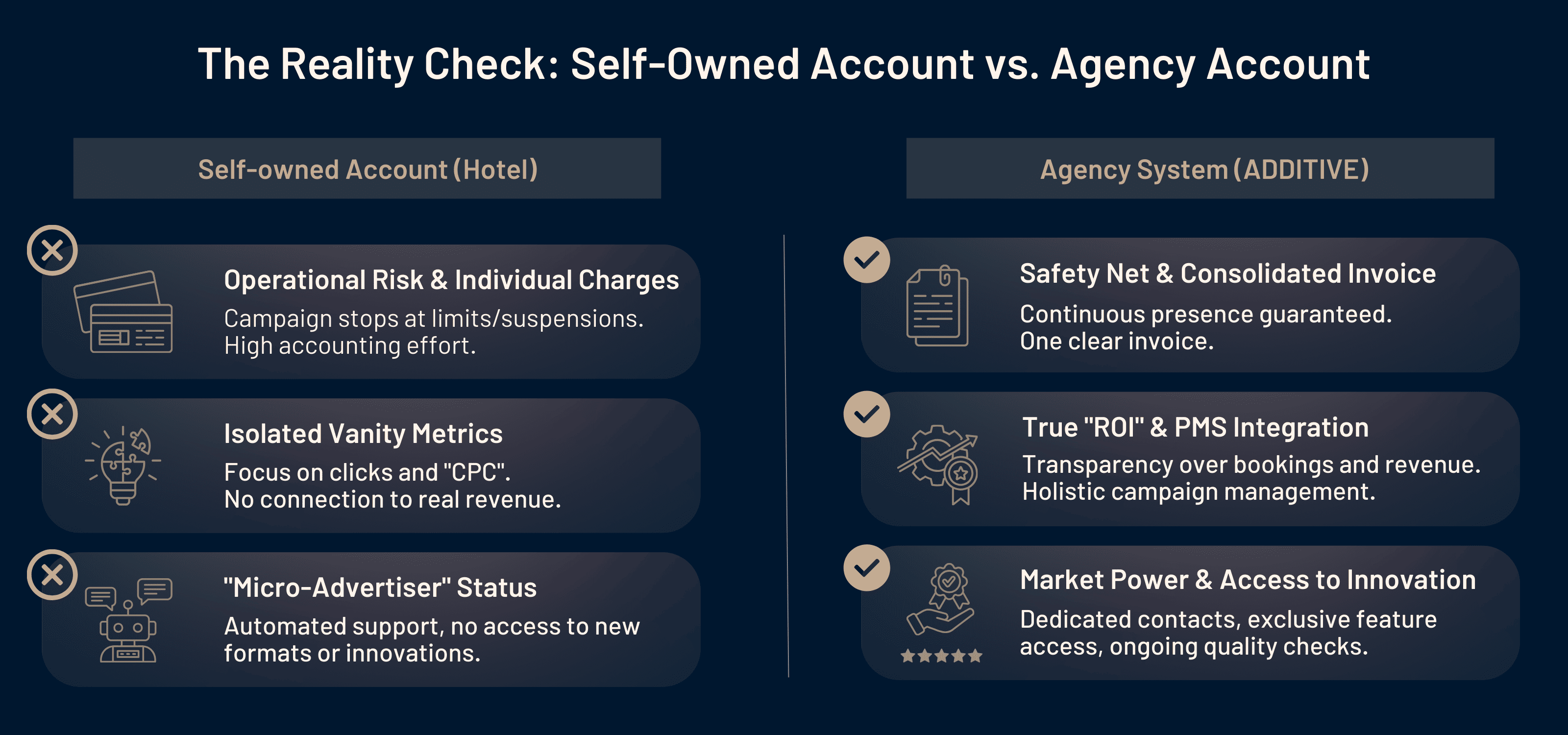
The desire for one's own account is understandable. At first glance, it promises independence, but in digital reality, it often pays for this with limitations: While the self-owned account suggests independence, in practice it often leads to technical isolation and the loss of market power against the platform giants.
Sovereignty and transparency in hotel marketing today are not created through the ownership of individual advertising accounts but through a contemporary entrepreneurial approach to the topic of hotel marketing. At ADDITIVE, this means:
- Away from the lone warrior, towards market power:
Instead of fighting in the advertising market as a "micro-advertiser," you benefit from a technological ecosystem through our official partnerships with global advertising platforms. This secures you access to innovations, beta features and data quality that are otherwise reserved only for large corporations.
- The holistic system as a guarantor of transparency:
True transparency lies in networking the individual advertising channels. While isolated ad accounts only count clicks and impressions, ADDITIVE's holistic online marketing system offers a completely new level of clarity: You have 24/7 access to the results that matter most to hotels: real inquiries, confirmed bookings, and measurable revenue directly from your hotel system (PMS).
- Accompanied access with expert know-how:
Anyone who, in addition to unlimited access to the evaluation dashboards from ADDITIVE, still wants insight into the individual advertising accounts will receive this upon request. The decisive difference: We do not leave you alone with the complex data but interpret it together in the context of your individual goals and results in a personal exchange.
Whoever decides to work with ADDITIVE - and thus also for an agency account at ADDITIVE - does not give up control but profits from maximum market power with advertising platforms, personal support by experts, and a seamless performance review that goes far beyond the classic advertising account.

- Increase sales per guest
- 8 tips on how to make guests return
- Using marketing automation successfully in hotels
- What to consider when choosing software

- Increase sales per guest
- 8 tips on how to make guests return
- Using marketing automation successfully in hotels
- What to consider when choosing software
Book your Hotel Marketing Consultation:
15-Minute Expert Session - Free & without Obligation
- Exclusive one-on-one video call — free of charge, with no obligations
- In-depth assessment of your current digital marketing setup
- How to leverage guest data to drive direct revenue growth
- Proven strategies to boost occupancy and booking performance
Frequently Asked Questions
- Increase sales per guest
- 8 tips on how to make guests return
- Using marketing automation successfully in hotels
- What to consider when choosing software